

Ice Hockey Association of Thailand

Who we are

History of
the Ice Hockey Association of Thailand

( ICE HOCKEY ASSOCIATION OF THAILAND : IHAT )

Sports played on ice rinks—namely ice skating and ice hockey—offer numerous benefits. Like many other sports, they help enhance physical and mental well-being for participants.

In the past, His Majesty King Rama VIII and His Majesty King Rama IX, during their youth while residing in Lausanne, Switzerland, also took part in these sports. Many Thais living abroad have likewise had the opportunity to enjoy them whenever interest and access allowed.

Today, a growing number of Thais, both in Thailand and overseas, continue to participate in ice sports, reflecting the increasing popularity and appreciation of these activities within the Thai community.

              In Thailand, the development of ice sports began around 1975, when a group of Japanese investors established one of the country’s first large indoor ice rinks on New Phetchaburi Road in Bangkok. The rink was built near standard size and soon became a central hub for various ice sports—especially ice hockey, which quickly captured the interest of Thai youth and the general public. 
 
              Foreign residents living in Thailand at the time—particularly those from nations with strong ice hockey traditions such as Japan, Switzerland, Germany, the United States, and Canada—not only played among themselves, but also helped introduce and teach the sport to Thais. Some Thai players who had previously played abroad also joined in, eventually forming a group sizeable enough to organize friendly matches between Thai and international teams.
 
              As the sport gained popularity, a group of former students from Japan—one of whom was an officer in the Royal Thai Navy—collaboratively founded the Skating Association of Thailand in 1976, under the supervision of the Sports Promotion Organization of Thailand. Rear Admiral Venus Sirikaya became the association’s first president. Operations progressed well until 1978, when the only ice rink in Thailand suffered a major fire and was never restored. This incident brought the development of ice hockey, as well as the work of the association, to a halt.
 
              Despite the setback, the founding members remained determined to revive ice hockey in Thailand. Over the next several years, they continued advocating for the sport and, in 1986, amended the association’s regulations to align with the requirements of the Sports Authority of Thailand (SAT). As a result, the association was officially re-established and registered as the Skating Association of Thailand on 12 June 1990.
 
              Soon after, a group of Thai–Japanese business investors built a new ice rink at The Mall Ratchaprasong. Initially used primarily for recreational ice skating, the demand for ice hockey space continued to grow. This led to the expansion of additional indoor ice rinks within commercial centers—beginning with The Mall Ramkhamhaeng, which became the primary venue supporting the rapid growth of ice hockey.
 
              At that time, Rear Admiral Venus Sirikaya still served as president and successfully secured Thailand’s membership in the International Ice Hockey Federation (IIHF) in 1989. Annual membership fees of 500 Swiss francs (approximately 14,000 THB) were supported by the Sports Authority of Thailand.
 
              IIHF membership significantly accelerated the development of ice hockey in Thailand. The association received support from both public and private sectors, as well as international partners—including Japan and Sweden—which provided equipment, coaching assistance, and regularly organized friendly matches.
 
              In 1993, the association faced a great loss when Rear Admiral Venus Sirikaya, its founder and long-serving president for 18 years, passed away. Vice President Rear Admiral Phimol Hatyee succeeded him as president from 1993 to 1995. During this period, ice hockey once again surged in popularity, prompting new rinks to open in several shopping centers, including: - The Mall Tha Phra - The Mall Ngamwongwan - Imperial World Ladprao - Imperial World Samrong - Zeer Rangsit - World Trade Center
 
              At the end of 1995, Rear Admiral Phimol Hatyee resigned due to age and health concerns. Admiral Atikom Hoontrakul was then appointed as president from 1996 to 1999, with Mr. Anukul Chaikiat serving as secretary-general. During their term, several major events were introduced, such as: - The Thailand National Ice Hockey Championships - The Princess Soamsawali Cup - The Thailand Ice Hockey League
 
              During the 2001 Annual General Meeting, held on 4 December 2001, a new executive committee was elected. At its first meeting on 18 December 2001, the committee unanimously selected General Pisan Chuprapath as president. A significant milestone was the amendment of the association’s regulations—changing its name from the Skating Association of Thailand to the Ice Hockey Association of Thailand (IHAT). The association also adopted a new official emblem, approved by the Sports Authority of Thailand on 29 May 2002. The IIHF was formally notified of the change during the 2002 IIHF Annual Congress in Gothenburg, Sweden.
 
              International participation also increased. After Shoichi Tomita, a Japanese official, was elected IIHF Vice President in 1994, the IIHF intensified its development programs in Asia and Oceania. This included organizing the U18 Asian-Oceanic Championships, with 12 member countries participating. Thailand first competed in 1998 in Beijing, China. In 1999, the team planned to compete in North Korea but withdrew due to security concerns following a hijacking incident, resulting in a fine of 27,448 Swiss francs (approx. 769,000 THB) for cancellation.
 
              The year 2000 marked one of the strongest periods of growth for ice hockey in Thailand, when the country hosted the Asian-Oceanic Championships at Imperial World Samrong. However, economic challenges—especially the effects of currency devaluation—led to the closure of many ice rinks. Ultimately, only one rink remained available for hockey: Imperial World Ladprao.
 
              Despite this, Thailand continued to participate internationally. In 2001, the national team competed in South Korea. Additionally, Chiang Mai welcomed its first ice rink at Kad Suan Kaew, helping expand the sport beyond Bangkok. In early 2002, the IIHF hosted its final Asian-Oceanic Championship in Auckland, New Zealand. Six countries were promoted to compete at the world level, prompting the remaining nations—including Thailand—to raise their development standards to IIHF requirements. Thailand sent coaches, referees, and two players to the IIHF development camp in Karuizawa, Japan (20–24 July 2002), aiming to elevate coaching and officiating standards domestically.
 
              IHAT co-hosted the IIHF/Asia Development Program Workshop on 15–17 November 2002 in Chiang Mai, attended by representatives from Taipei, Mongolia, India, Hong Kong, Singapore, and Thailand. A joint agreement established a five-year development plan (2003–2007), with each country alternating as host for training camps and friendly competitions. Thailand hosted the first camp from 9–13 August 2003, followed by Taipei (2004) and Hong Kong (2005).
 
              The association also oversaw Inline Hockey, originally scheduled to be included in the 2005 Asian Indoor Games hosted by Thailand, but later removed from the program. Despite this setback, IHAT continued developing both ice hockey and inline hockey in parallel.
 
              One of IHAT’s long-term goals has been the establishment of a national ice rink under the Sports Authority of Thailand. High rental costs have always posed challenges for athlete development, and a dedicated national facility would significantly strengthen Thailand’s ice hockey infrastructure. The association envisioned a central ice rink and an inline hockey rink to support both on-ice and off-ice programs. By 2008, Thai hockey athletes relied primarily on two venues: - Imperial World Samrong - Imperial World Ladprao

IHAT was officially admitted as a member of the National Olympic Committee of Thailand on 5 November 2002, enabling Thailand to participate in winter sports activities at the international Olympic level.

5th Winter Asian Games Aomori 2003

Thai ice hockey athletes aged 18 and over participated in the Winter Asian Games for the first time at the 5th Winter Asian Games Aomori 2003, held from 1–8 February 2003 in Japan.

The final results were: 1st Place (Gold) – Japan 2nd Place (Silver) – Kazakhstan 3rd Place (Bronze) – China 4th Place – South Korea 5th Place – Thailand

In the classification match for 5th place, Thailand defeated Mongolia, securing a memorable victory. On that day, Thai athletes and supporters proudly sang the Thai national anthem as the winners’ flag was raised—marking a meaningful moment of pride for everyone involved in the competition.

The Thailand Men’s National Ice Hockey Team participated in the 6th Asian Winter Games Changchun 2007, marking the team’s second appearance at the Asian Winter Games.

The event was held from 28 January to 4 February 2007 in Changchun, People’s Republic of China.

Thailand finished the tournament in 7th place.

The Thailand Men’s National Ice Hockey Team made its third appearance at the 7th Asian Winter Games Astana & Almaty 2011.

The tournament was held from 31 January to 6 February 2011 in Astana and Almaty, Kazakhstan. For the 2011 Games, a new competition format was introduced: teams were divided into groups based on their IIHF world ranking. Higher-ranked teams competed within the top group, while lower-ranked teams played in a separate division to ensure more balanced and competitive matchups. Medals were awarded separately for each group.

Thailand competed in the Premier Division and achieved an impressive 2nd place, earning the silver medal.

The Thailand Men’s National Ice Hockey Team made its fourth appearance at the 8th Asian Winter Games Sapporo & Obihiro 2017.

The event was held from 19–26 February 2017 in Sapporo and Obihiro, Japan. Notably, the Thailand Women’s National Ice Hockey Team also participated in the Asian Winter Games for the first time during this edition.

The Thailand Men’s National Ice Hockey Team competed for the first time at the 29th SEA Games Kuala Lumpur 2017, marking the debut of ice hockey in the Southeast Asian regional multi-sport event. The tournament was held in Kuala Lumpur, Malaysia.

The competition took place from 20–24 August 2017 at the Empire City Ice Arena in Selangor.

Thailand delivered an impressive performance and finished in 2nd place, earning the silver medal.

The Thailand Men’s National Ice Hockey Team participated in the 30th SEA Games Philippines 2019, marking the second time that ice hockey was included in the Southeast Asian Games.

The event was held from 30 November to 11 December 2019 in Manila, Philippines. Five men’s teams competed in the tournament. During the round-robin stage, Thailand won all four of its matches, finishing 1st overall. In the semifinals, held at the Mall of Asia in Manila, Thailand defeated Malaysia with a decisive score of 15–0.

Thailand went on to win the tournament, finishing in 1st place and earning the gold medal. At that time, Thailand was the only ASEAN nation listed in the IIHF World Ranking, where the country held the 51st position.
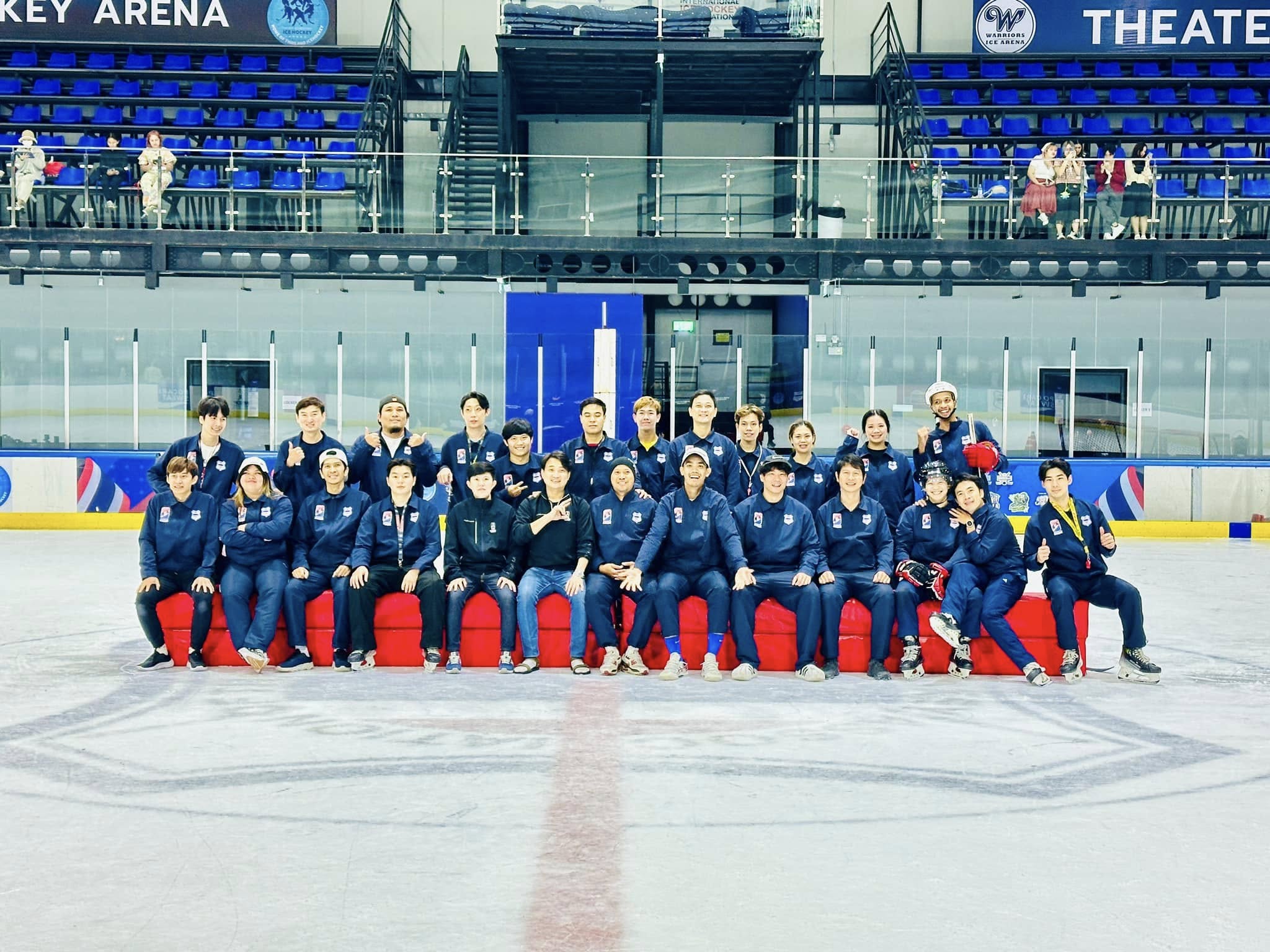
Club members
Executive Committee
Executive Directory
Our value

“The Ice Hockey Association of Thailand is committed to developing athletes and personnel to meet international standards, while nurturing youth players from the foundational level to excellence, with the goal of achieving success in Asian-level competitions.”

Our Vision

The Ice Hockey Association of Thailand is dedicated to developing and promoting athletes and all sports personnel—including referees and coaches—to reach international standards. The association aims to achieve excellence in Asian ice hockey and attain success in international competitions.

Our Mission